Published: August 1, 2026
Few issues matter more to Riversiders than homelessness, and very few are more challenging to address. I know many residents feel frustrated when they don't see immediate results. The reality is that meaningful progress rarely comes from a single action. Meaningful progress comes from coordinated efforts happening every day through law enforcement, outreach, housing, code enforcement, legal action, and state advocacy.
Holding Problem Properties Accountable
One example is the Magnolia corridor, which has long experienced persistent crime, nuisance activity, and concentrations of homelessness. The City launched a coordinated effort to hold negligent property owners accountable and as part of that effort five motel owners were billed for the extraordinary costs generated by repeated police responses to their properties. The Riverside Police Department increased enforcement through regular patrols and targeted operations while the City's Public Safety and Engagement Team (PSET) continued to connect individuals experiencing homelessness with available services.
And after more than two years of investigation and legal work, the City successfully obtained a court-appointed receivership for the Riverside Inn & Suites on Magnolia Avenue. Receivership is one of the strongest enforcement tools available under California law. After documenting years of criminal activity and unsafe conditions, the City Attorney's Office successfully demonstrated that court intervention was necessary.
A court-appointed receiver now has full authority to manage the property, collect revenue, pay expenses, hire licensed contractors, and make the repairs necessary to bring the property back into compliance. The Riverside Inn & Suites is the first of five properties where the City is pursuing similar legal remedies. This success reflects years of collaboration between the Riverside Police Department, Code Enforcement, the City Attorney's Office, and former Councilmember Jim Perry, who championed this effort throughout the process.
Addressing Encampments Along State Freeways
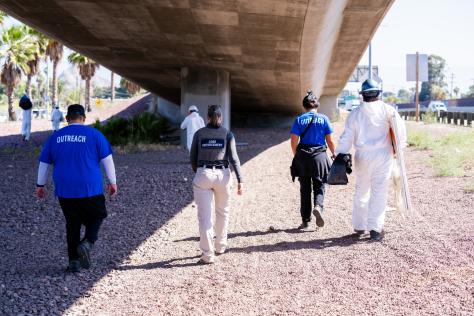
Another example of this coordinated approach is our work to address encampments along state freeways. Until recently, Riverside could not directly address encampments located on state-owned freeway property because those areas fall under Caltrans jurisdiction. Riverside became one of the first cities in California to enter into an innovative agreement with Caltrans that allows our PSET teams to conduct outreach, remove debris, and connect people with services while being reimbursed by the state.
Since this agreement took effect, City crews have
- Mitigated 728 encampment locations
- Removed more than 91 tons of debris
- Issued 246 code violations
- Made 48 arrests
Strengthening Regional Coordination
Another important step was the adoption of a new ordinance requiring organizations to notify the City before transporting an unhoused individual into Riverside. The goal is simple: to ensure services can be coordinated before someone is dropped off, rather than after the fact.
Despite significant investments by both the City and State, the supply of emergency shelter beds and affordable housing remains limited. At the same time, Riverside serves as a regional hub for hospitals, behavioral health facilities, shelters, recuperative care programs, and the county jail. Because of this, too often individuals are transported into Riverside without prior coordination or a plan for supportive services, placing additional strain on already limited local resources and reducing our ability to respond effectively to those already here. The new ordinance is intended to improve coordination, not prevent people from receiving care.
Organizations transporting an unhoused individual into Riverside must provide written notification at least 24 hours in advance. This allows City staff and service providers to coordinate available resources, identify the jurisdiction of origin, and help ensure individuals are connected to appropriate services rather than released into the community.
Just as importantly, the ordinance reinforces that homelessness is a regional challenge requiring regional solutions. By tracking where individuals are being transported from, Riverside can work more effectively with neighboring jurisdictions and service providers to improve coordination, strengthen accountability, and ensure responsibility is shared rather than shifted from one community to another.
That coordination matters because homelessness response requires significant resources. According to City estimates, it costs approximately $63,000 to provide the shelter, rental assistance, housing navigation, case management, and outreach services needed to stabilize one unsheltered individual. Better coordination helps ensure those limited resources are used wisely while improving continuity of care for the people who need them most.
Advocating for State Resources
While we continue taking enforcement action here at home, addressing homelessness also requires sustained investment. That's why we are fighting in Sacramento to ensure Riverside has the resources needed to continue this work.
Each year, cities across California rely on the state's Homeless Housing, Assistance and Prevention (HHAP) program to fund many of the services that help move people off the streets and prevent others from becoming homeless. This year, as Chair of the California Big City Mayors Coalition, I led mayors from across the state advocating to protect this funding.
We successfully secured $900 million for HHAP Round 7 to address homelessness across California. We also successfully advocated for stronger accountability by ensuring unspent HHAP dollars remain dedicated to homelessness efforts and are redistributed to communities making progress, rather than reverting to the State's General Fund.
Of that funding, Riverside County, the City of Riverside, and the Riverside City & County Continuum of Care are anticipated to receive approximately $20.4 million, including roughly $10 million directly for the City of Riverside.
So what does that funding accomplish? As of March, HHAP funding has helped Riverside
- Serve 2,456 individuals
- Create 133 shelter beds
- Provide Rapid Rehousing Assistance to 125 individuals
- Provide prevention assistance to 202 households
- Engage with 497 individuals
Following changes to the Quality Inn project, HHAP funds are being reallocated to maximize their impact, including expanding rental assistance, supporting 25 units at Mulberry Gardens Senior Apartments, and investing in other eligible homelessness response activities.
Looking ahead, Riverside's most recent allocation will continue supporting:
- Emergency shelter operations
- Rental Assistance Program
- Shared Housing Program designed to expand access to safe, affordable housing opportunities.
One thing you'll notice is that prevention is a major focus, that's intentional. 1 in 5 people experiencing homelessness in Riverside are doing so for the first time. Helping someone remain housed is not only life-changing for that individual, but also one of the most effective and fiscally responsible ways to reduce homelessness.
These aren't just numbers in a budget. They translate directly into services that help people move off the streets, connect them with supportive services, and stabilize families before they lose their housing.
Homelessness cannot be solved through any single program, enforcement action, or funding source. It requires persistence, coordination, and long-term investment. Every shelter bed created, every person connected to services, every encampment addressed, and every family kept in their home represents meaningful progress. While there is still more work ahead, Riverside remains committed to building a city that is safer, healthier, and more compassionate for everyone.