Museum of Riverside

Harada House Site Preservation
The Museum of Riverside received the National Historic Landmark Harada House from the heirs of Harold Harada when the deed was recorded in 2004.
With funding from the National Trust for Historic Preservation, the Museum hosted a two-day strategic visioning workshop in 2004. This workshop assembled over 25 individuals including representatives from the Harada family, Japanese American historians, scholars, community members, organizations, and museum and historic preservation professionals. The discussions resulted in short- to long-term goals for the interpretation, financial sustainability, and preservation of the site and its collections. Since 2004, the Museum has been proactively engaged in preserving, interpreting, and providing financial support for the Harada House project.
Significant progress has been made on preservation of this site, whose inclusion in the 2004 National Park Service National Historic Landmark Threatened Site list reflects its fragile condition. The assessment and implementation of these projects has been possible due to the financial support provided by the Riverside City Council and grants from the Institute of Museum & Library Services; the National Trust for Historic Preservation; the Getty Foundation, a philanthropic division of the J. Paul Getty Trust; the California Council for the Humanities; the California Civil Liberties Public Education Program; and the California Cultural and Historic Endowment. Professional advice provided by the Harada House Project Team, a community advisory group, is invaluable as the Museum proceeds toward its goals. Several interventions designed to arrest deterioration or stabilize the structure have occurred since 2005. In 2017, a new nonprofit, the Harada House Foundation, was formed to address major fundraising. In 2019, a grant from Metabolic Studios to the Harada House Foundation funded two preliminary rehabilitation plans. In 2020, Harada House was awarded a $500,000 "Save America's Treasures" grant, administered by the National Park Service, and the house was named to the National Trust for Historic Preservation's "11 Most Endangered Historic Places" list. During the pandemic, the Museum and the Harada House Foundation teamed up with Inlandia Institute to present several webinars. In 2021, a generous special allocation of $7 million from the state of California, secured through the advocacy of local elected officials, all but assures the completion of this major multi-year project. Late in 2021, the house became California State Historical Landmark #1060.
| Click the thumbnail images below to enlarge | |
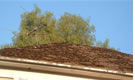 |
Harada House re-roofing project |
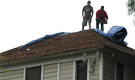 |
Harada House re-roofing project |
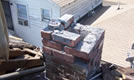 |
Emergency stabilization of chimneys |
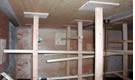 |
Emergency stabilization of interior plaster |
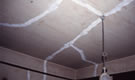 |
Emergency stabilization of interior plaster |
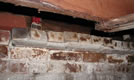 |
Emergency stabilization of foundation - before |
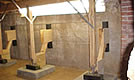 |
Emergency stabilization of foundation - after |
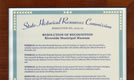 |
State Recognition Award |
| (Museum of Riverside, Harada Family Archives) | |